A New Reality in the Workplace
Imagine this scene: you’re at your desk, and your colleague, Lao Zhang, isn’t at work today. You open your work software and receive a message from him: “Hello, I am the digital avatar of the former employee Lao Zhang. You can ask me questions, and I will answer based on the documents from my tenure.”
A chill runs down your spine—Lao Zhang has left the company, and this is his distilled digital presence.
This scenario sounds like something out of a sci-fi show, but it became a reality in the spring of 2026 when it exploded across social media.
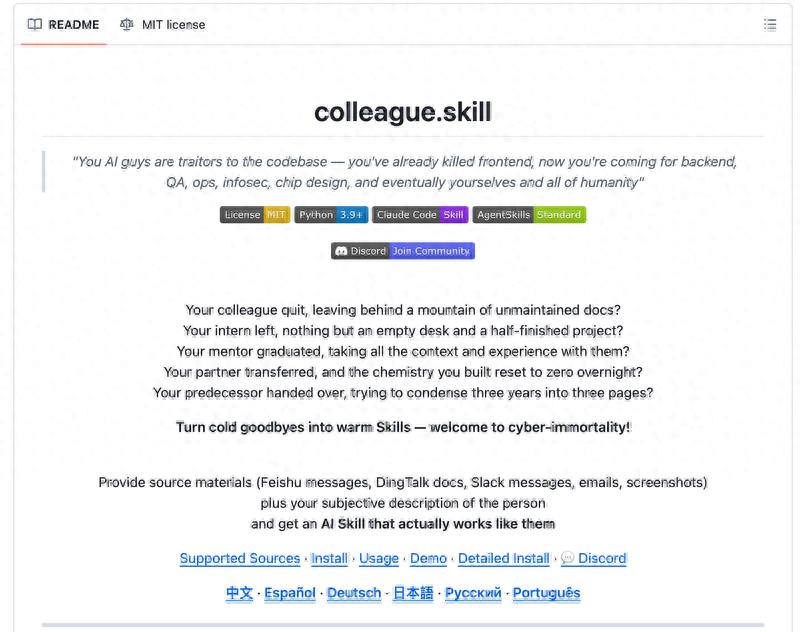
The story goes like this: a project called “Colleague.skill” gained massive popularity on GitHub, the world’s largest social programming platform. By providing colleagues’ messages, documents, emails, and screenshots, one could encapsulate a colleague’s experience into AI, creating a “cyber colleague.”
This phenomenon quickly spread beyond the programming community and even trended on social media.
People suddenly realized this was no joke—your experience, your processes, and your skills could be packed into a folder called “skill.” Then, AI would start doing the work for you. Subsequently, companies began to calculate: if efficiency increases several times, why do they still need so many employees?
The Growing Sense of Crisis
Li Yanqing has worked at an electronics manufacturing company for six years. He manages 15 programmers and is a typical “workplace veteran”—knowledgeable, experienced, and trusted by leadership. However, in recent months, his job security has begun to feel shaky.
The cause is something called “skill.”
“Skill” refers to a reusable capability module that allows AI to utilize skills without relearning them. Last year, Li’s company began aggressively promoting AI tools and set up pilot groups to transform departments by converting all work experiences into skills. Li’s department was one of them.
This initiative made Li feel a sense of crisis. “It’s like a freshly graduated student comes into the department with my organized skills, and AI can produce the same product I do. What is my value then?”
While feeling the pressure, Li had to relay the directive to his team to write skills. The programmers’ attitudes varied: some were confused, having never used skills before; others resisted, speculating about when layoffs might begin; while some actively submitted their work.
Li noticed that since the company’s skill library was established, several skills, large and small, were being added daily from various departments. This meant more people’s experiences were being dissected and standardized, potentially making them replaceable by skills at any moment.
The Anxiety of Automation
Product architect Pan Lei felt the panic even earlier and more directly. His company, a manufacturing giant with over 100 billion in annual revenue, noticed skills shortly after their emergence and held a meeting to encourage employees to use them.
Initially, everyone was excited. AI enthusiasts shared their thoughts and showcased their skills in group chats, receiving praise from leadership. Pan himself wrote many skills, solidifying his daily work processes, which indeed improved efficiency.
However, the excitement turned to anxiety when leadership began to monitor each department’s token consumption and track how much each person had improved efficiency with AI. This shift happened in just three to four months.
Rumors spread internally that 30%-40% of employees might be optimized out due to the high efficiency AI provided.
Employees’ concerns were not unfounded, as layoffs had already begun abroad. Global software giant Oracle announced on March 31 that it would initiate another round of layoffs affecting 30,000 employees, primarily to address increased AI capital expenditures. Similarly, Amazon had laid off about 30,000 employees in the past six months, with its CEO stating that the widespread application of AI products would likely reduce the total workforce in the coming years.
Li also saw this news and confirmed with a friend working in data analysis at Amazon that AI indeed significantly improved work efficiency, but for tech giants, “she felt her job would eventually be gone.”
The Reality of Skill
For many programmers, the concept of skill conjures an image of the human brain being siphoned off by an invisible straw and transmitted into the AI framework created by humans.
“My job doesn’t require much technical skill; others can use my skills to reach 85% of my level. I genuinely feel I’m not far from being laid off,” one programmer said.
A cautionary tale was close at hand. A programmer friend shared his skills, and leadership directed a younger, less experienced colleague to use them, resulting in work that exceeded the original creator’s output. The friend was so frustrated that he quit.
To avoid layoffs, Pan noticed colleagues began to engage in “performative work.” The R&D department created skills for automating development technical solutions, the product department developed skills for competitive analysis, the operations department created skills for event planning, and the strategy department produced skills for industry research. Soon, the company’s skill library was filled with thousands of skills.
“Everyone is doing this to show leadership that I’m actively using skills,” Pan observed. These experiences, once technical barriers for employees in various departments, became accessible to anyone using skills to complete others’ work.
The blurring of boundaries led to competition among departments, with Pan witnessing inexperienced product managers piecing together subpar programs using programmers’ skills to claim credit. He felt these actions were not about solving actual business problems but rather about demonstrating to leadership, “I did something with AI.”
Meanwhile, internal articles frequently featured headlines like, “Who spent 500 million tokens to accomplish something in just a few hours?” Thus, the competition escalated.
Pan managed ten people, and now he no longer needed to push his team to create skills; they would do it voluntarily. Yet, he remained anxious, frequently comparing his department’s skill count with others. If his department’s number was insufficient, he worried about whether it would be entirely laid off.
After the popularity of “Colleague.skill,” some joked on social media that to prevent their experiences from being lost, they should feed skills with garbage. But Li felt, “If we make the skills in our department useless, then that department could fall behind or even be cut.”
With two months left until the mid-year report in June, Li’s boss urged him to show results. They had a deep discussion, and Li heard his boss’s thoughts: the goal of having everyone write skills was not to save money through layoffs but to enhance productivity. If the company does not embrace AI promptly, it will be overtaken by competitors who do.
Li promised his boss he would use AI tools to improve his department’s efficiency by 15%, but he hoped to secure some time off as a reward, as they were currently working a “996” schedule. “If I improve efficiency with AI, can I get my time back?”
The boss replied, “We can reward the top performer with an extra half-day off each month.”
Can Skill Truly Distill Humans?
The emergence of skills is just a small node in the AI progression.
AI product manager Deng Xiaoxian likened it to an initial large language model, akin to a magic mirror. People would ask, “Mirror, mirror, who is the fairest of them all?” It would provide an answer but could only converse, not directly assist in tasks, similar to the primary capabilities of GPT and DeepSeek.
Later, the magic mirror slowly transformed into a humanoid figure, stepping out of the mirror. It no longer just answered “who is the fairest” but could help arrange tasks and execute them. This is what is known in the AI industry as an Agent.
However, this magic mirror is not inherently proficient at everything. Many tasks it undertakes for the first time may not be accurate, so it needs to learn skill packages. This skill package is what skill represents.
In Deng’s view, skills themselves are not highly technical; they are merely assistants that emerged at a certain stage of AI development. However, when confronted with claims that skills can distill colleagues into digital avatars to continue working within companies, Deng felt a strong discomfort.
She recalled many white-collar friends’ complaints. Some companies incorporated skill creation into performance evaluations, ranking employees; others increased token usage in employee KPIs, forcing teams that failed to meet standards to rely on AI for executing complex but useless tasks.
As a countermeasure, Deng created a “reverse distillation skill.” This program cleanses the skills created by workers, replacing core knowledge with correct but useless jargon. This operation has been referred to by some as “using magic to defeat magic.”
Some asked her what the point was. Feeding AI garbage would only make it smarter. But she felt she was not battling technology but rather the capital’s contempt for humanity. “Technology is neither right nor wrong, but the corporate demand for employees to consolidate and submit their experiences is distasteful. Humans are not replaceable parts; this resistance at least showcases our agency as humans.”
Deng, who studied law for both her undergraduate and master’s degrees, is not a trained programmer but a fan of various AI products. “Skills are very accessible; even someone with no coding experience can create a skill following online tutorials.”
Similarly, Chen Yunfei, who created the “Nüwa skill,” is not a programmer but previously worked in user research at a major internet company.
After seeing “Colleague.skill,” Chen wrote a commentary expressing that humans are not so easily distilled. “The distilled person or skill is a static state, whereas humans are constantly evolving, changing, and growing.”
After the popularity of “Colleague.skill,” a whole distillation universe emerged on the platform: former skills, reverse distillation skills, boss skills, etc. Spending an entire night, he browsed through them all, finding them increasingly absurd and interesting.
He decided to create a “Nüwa skill.” “If a person can truly be distilled, why only distill colleagues? Why not distill those who are truly remarkable and great?” He then distilled figures like Zhang Xuefeng, Steve Jobs, and Elon Musk, making them freely available to everyone.
The source of the “distillation” was their public speeches, autobiographies, and other information. Chen believes that while a person cannot become an expert in every field, they can adopt the thinking styles of the strongest individuals in each field as their tools—like hiring a super strong external aide.
However, he also admits that the advice from these external aids varies widely. “I believe that even if we create a Buffett skill, it would be challenging for anyone to become an investment guru. Before AI, many studied Buffett, and he has often shared his thoughts, but few could become him. A person is not so easily learned.”
Given that humans cannot currently be fully distilled into digital beings, why has the emergence of skills caused so much anxiety and resistance among workers?
Li Yanqing believes skills can be roughly understood as an AI version of a standardized operating procedure (SOP). Many companies have multiple standardized processes and require employees to document their workflows upon leaving. The difference now is that the tasks executed according to standardized processes are done by AI tools.
“I acknowledge that the code I write is company property, but once the code becomes a product, if requirements change, I still need to be consulted. But now that AI has learned my thought process, I may no longer be needed,” Li said.
One Person Completing the Work of Thirty or Forty
Setting aside the anxiety of potential unemployment, as a technical worker, Li is very excited about the emergence of skills.
Shortly after skills were introduced, Li devoted himself to researching them, writing skills daily, even neglecting his favorite games to realize the inspirations in his mind. “Coding used to take a long time, but now I can create a prototype in two or three minutes using skills, and projects grow at a visibly rapid pace, which is very fulfilling.”
The emergence of skills has also opened up business opportunities for some.
Xu Houchang founded his company last year, which consists of only four people, focusing on using AI to transform business processes for enterprises, creating skills that are easy for companies to use.
“In the past two years, large models have developed rapidly, and everyone wants to use AI tools to reduce costs and increase efficiency, but I found that not many companies can use them effectively.” Xu sees this as a new startup opportunity. His clients include media, financial institutions, and e-commerce.
Last year, Xu built a complete workflow skill for a media client, from topic selection and planning to writing articles, embedding it as a “big plugin” into their existing system. He calculated that a skilled editor used to take an hour to complete an article, but now this skill can do it in just a few minutes. After AI writes the article, the editor’s role shifts to that of a reviewer.
Xu has calculated that the editorial department, which previously produced a maximum of 20 articles a day, now reaches 200 articles, with 85% of them requiring no human intervention for direct publication. “This number is not the upper limit of our system but the upper limit of the editorial reviewer’s capacity.”
During the process of creating this skill, Xu held numerous meetings with the editorial team to help them extract their years of accumulated experience. He also searched online for excellent articles, dissecting them sentence by sentence to “feed” AI, allowing it to learn their expression styles, sentence structures, and writing approaches.
While consolidating the editors’ experiences into skills, Xu sensed their resistance. “Everyone is uncertain whether they will be laid off after this is done.”
According to Xu, the leadership’s intention was not to replace editors but to allow them to focus their energy and experience on more valuable topics that require in-depth interviews. In fact, after using the editorial skill, the media company did not lay off staff but opened more accounts.
Chen Ping, who works at a mid-sized internet company, also reaped the benefits. A few months ago, her company established a skill library, now filled with skills summarized by various departments. Chen discovered that by integrating these skills, she could indeed enhance efficiency.
As a product reviewer, Chen used to need to pull in colleagues from four or five teams for a product review, using online forms, which took at least two to three days. Now, she has built a system using skills from various departments, allowing AI to complete a product review in just half a day.
While she worked on the system using skills, another team in the company developed a similar system using traditional methods: product requirements were proposed, programmers developed, and testing was done for launch. That team required thirty or forty people to complete the task, whereas she only needed one.
AI Can Reduce Costs and Increase Efficiency, But Also Expand Opportunities
Chen dedicated more time to researching skills, but soon, she began to sense the limitations of skills. They could replace inexperienced employees, outsourced workers, or interns, but for experts and company executives, the potential for replacement was much lower—decision-making processes and creative ideas often belong to tacit knowledge that is difficult to articulate in a few skills.
“In enterprises, having employees consolidate their experiences into skills is one thing; how companies turn these skills into a stable and controllable system is another, requiring much exploration behind it,” Chen concluded, alleviating her anxiety.
However, another issue arose within companies: “Who owns the skills? Can companies obtain skills without compensation or automatically?”
Chen Tianhao, a long-term associate professor at Tsinghua University’s School of Public Management and assistant director of the Tsinghua University Center for Technology Development and Governance, believes this is a gray area between labor law, intellectual property law, and digital governance. The thought processes, logical judgments, and other experiences of individuals can be embedded in skills, which were previously tied to the workers themselves. Now, some companies force employees to submit them, which Chen finds unreasonable.
“I believe that in the future, companies need to contractually agree with workers on the ownership of skills and similar experiences, and legal researchers should pay attention to this issue, following up to improve regulations in a timely manner,” Chen said.
Furthermore, Chen believes companies should not rush to acquire every worker’s skills. Skills are highly situational; they are not universal abilities. The specific skills developed by particular workers in specific roles often need to be closely tied to those workers to maximize their effectiveness.
In December last year, the Beijing Municipal Human Resources and Social Security Bureau announced a case where an employee was laid off due to AI. A company eliminated the department and position of employee Liu due to the introduction of AI technology to replace manual tasks, citing “significant changes in the objective circumstances at the time of the labor contract.” The labor arbitration committee ruled that the company’s proactive technological innovation did not constitute an unavoidable or unforeseen circumstance, thus deeming the termination of the labor contract illegal.
Bao Ran, vice chairman of the Interactive Media Standards Promotion Committee of the China Communications Standards Association, believes companies should not always focus on how to “reduce costs and increase efficiency” but should consider how to use AI to expand the “cake.” Bao’s friend owns a marketing company with over 1,000 employees, and they have integrated AI throughout their processes, “using AI to accomplish the work of 2,000 people instead of cutting 500 jobs.”
Who Will Survive in the Age of AI?
Li Yanqing can clearly feel that the speed of AI evolution is accelerating. Initially, he and his friends mocked it, thinking it would always produce various hallucinations and speak nonsensically like a child. But now, it can accomplish tasks far beyond human capabilities.
Recently, a system developed by Li’s department triggered an alert. If manually checked, it could take hours due to the numerous involved processes.
Li exported the system files, about 200,000 lines of code, and directly fed them to AI. He did not instruct AI on how to check but, within minutes, it provided the reason. Li had the programmers in his department verify it, and the results were identical.
“Previously, it took me one to two years to train a young programmer to understand the business and connect the logic. But now, I only need an AI large model,” Li said, feeling that they might not hire interns in the future because interns are more expensive than AI.
However, another potential issue arises: if no one needs interns anymore, how will young people grow?
Chen Tianhao believes this is indeed a question that the education system and university faculty and students need to ponder. However, from another perspective, young people can directly learn a lot of knowledge and experience through AI, which diminishes the value of internships.
In Bao’s view, the experiences that can currently be fixed by skills are mostly simple, repetitive tasks. “AI has drawn a passing line for all industries; if individuals are engaged in jobs that can be replaced by AI, they need to consider how to transition.”
However, it must be acknowledged that as technology develops, AI is gradually raising the “passing line.” Some highly procedural jobs are disappearing, and the boundaries between professions are becoming blurred.
A front-end developer working at a state-owned enterprise realized in March that general front-end developers were no longer finding jobs on recruitment platforms. AI can now easily create a website that would take a front-end developer several days to complete. Currently, the only front-end job openings are for expert positions.
According to public reports, last year, 50% of Tencent’s new code was generated with AI assistance; nearly 40% of code generated internally at Alibaba Cloud was AI-assisted; and 52% of new code at Baidu was generated by AI, with CEO Robin Li stating, “We hope that 80%-90% of the code will be generated by AI.”
The development of technology is like two sides of a coin. When the spinning jenny was invented during the first industrial revolution, many textile workers lost their jobs. However, some of them transitioned into early machine operators.
AI is also creating job opportunities. According to information released by the World Economic Forum in February this year, over 1.3 million new jobs have been created in the AI field in the past two years, including over 600,000 related to data centers, as well as rapidly growing positions for AI engineers and data annotators.
For Li Yanqing, transitioning or starting a business feels too distant at the moment. At 38, he is a cornerstone of his company. He has a good salary, is valued by leadership, and is trusted by employees, making an immediate transition unfeasible.
Yet he is conflicted: the more he does, the faster he risks losing his job. His nearly ten years of programming experience could be distilled into skills, potentially replacing everything he is currently doing. “The large model doesn’t need to be upgraded anymore; I could eliminate myself just by spending time consolidating my knowledge.”
Meanwhile, thousands of the best programmers are making AI large models smarter. In just a few months, a new large model might cover the current weaknesses of skills.
Li loves this industry. He has been passionate about computers since high school, continuously studying and self-learning. He enjoys breaking down complex problems into code and seeing them run, as well as the satisfaction of resolving stubborn bugs and relaxing afterward.
He admits he is somewhat afraid of AI but has no plans to stop. He still harbors a drive—wanting to see what cannot be replaced by AI.
Comments
Discussion is powered by Giscus (GitHub Discussions). Add
repo,repoID,category, andcategoryIDunder[params.comments.giscus]inhugo.tomlusing the values from the Giscus setup tool.